Many were wondering what happened to Mohamed Salah’s hair after the Liverpool’s football player recently displayed a buzz cut. Rumors of a hair transplant were around, but the player never confirmed such rumors. Here we will try to answer, did Mo Salah have a hair transplant?
For people that have a good understanding of hair transplants and what the process looks like, by observing photos of Mo Salah on social medias, the answer is very clear and straightforward.

Besides displaying hair follicles where before there were none, there are other clear signs that prove Mo Salah had a hair transplant. Note: here we are not discriminating against hair transplants, we are actually very happy for Mo Salah and his results. This is a way to show what people can expect from hair transplants, so that they can make more informed decisions.
So, let us first jump in understanding how a hair transplant works and what are some of the signs that can help you spot one.
FUE (Follicular Unit Extraction) Hair Transplant
Hair transplants have been around for some time, with FUE (Follicular Unit Extraction) being the latest technique available for patients and surgeons. Hair grafts are taken from the sides and back of the hair (the donor area), and then transplanted where necessary, usually the top of the head (the transplant area). When compared to previous methods like the FUT (Follicular Unit Transplantation) where a whole strip is harvested from the back of the head leaving a very visible scar, with FUE single follicular units are extracted and then transplanted, leaving less noticeable small dotted scars.
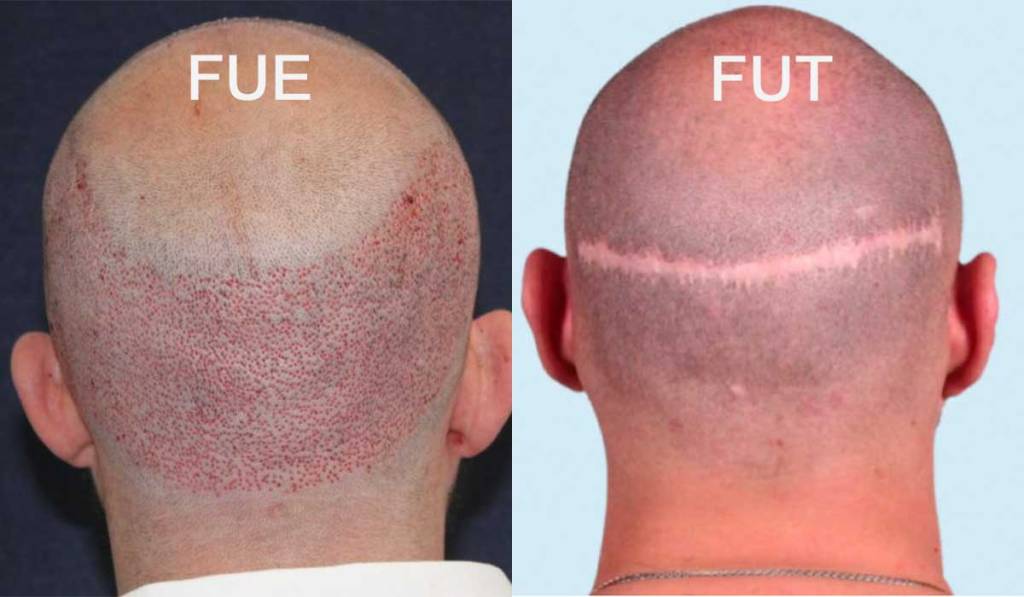
Social medias have plenty of material that illustrates the FUE process, from clinics promoting their work, to patients willing to share their journey and their results with the internet. These are the usual steps for for an FUE hair transplant:
- Shaving: the donor and transplant sites are shaved to facilitate the surgery. For improved discretion, some patients opt for a no-shave or shave-less hair transplant, where neither the donor nor the transplant sites are shaved.
- Anesthesia: the donor and transplant areas are numbed with local anesthetic.
- Donor graft extraction: grafts are extracted from the donor area using specialized tools. Every graft can consist of 1 to 4 or more hairs and they are placed in a glass tray with a solution to preserve them.
- Graft harvesting: the grafts are examined and separated into groups by thickness, size of the bulb and number of hairs.
- Implantation: grafts are implanted into the recipient area.
The aftercare is all down to the patient. Usually this is what they can expect:
- Swelling and redness are typical, especially in the forehead, and it might occur few days after the surgery. Swelling (also known as edema) can also spread to the eyes and nose area
- Scabs are formed at the donor and transplant site. They will consistently fall off during the first and second week following the surgery. When all crusts are fallen off, the scalp will appear pink and scabbed.
- Most of the implanted hair follicles will fall out, with the patient looking similar to how they were before the procedure. This is also called shock loss. This can start as early as a couple of weeks after the hair transplant and can last up to 12 weeks.
- After about 2 to 2.5 months, the new hair will start to grow.
- Good results are usually seen after 6 months, with hair growth that continues until the 1-year mark and beyond.
Did Mo Salah have a hair transplant?
Knowing the steps of the healing process, now we can analyze Mo Salah’s pictures to detect the signs of a hair transplant.
The first picture posted on social media where Mo Salah displays a buzz cut is from May 24th 2024. Some patients opt for a no-shave hair transplant, but we can assume that:
- End of May is when Mo Salah had his hair transplant.
- He opted to shave his head for the hair transplant.

You can see in the picture that the corners of the temples seem full, and the hairline is well defined.
As more pictures appear on social medias, it seems Mo Salah went under the shock loss phase, with scabs and hair follicles falling out, and the scalp appearing more pink. We can assume that:
- The first signs of shock loss can be seen at the beginning of June, hence few weeks after the hair transplant.
- The shock loss phase seemed to peak around July, thus a couple of months after the hair transplant.


After the shock loss phase, at about 2 months after the hair transplant, new hair is expected to grow. On social medias, Mo Salah’s pictures from end of August shows the re-growth, with a well defined hairline later on in September and October, thus roughly after 4 months from the surgery.

Conclusion
While Mo Salah has not publicly disclosed his hair transplant, the signs of a recovery from such procedure are clear. We are happy for him and the results that he is showing, with new hair that started to regrow after 4 months. The timeline of the recovery from hair transplant can be different from individual to individual, so take that into consideration when looking at photos or videos of hair transplants results online.
 TMD - Occlusion